
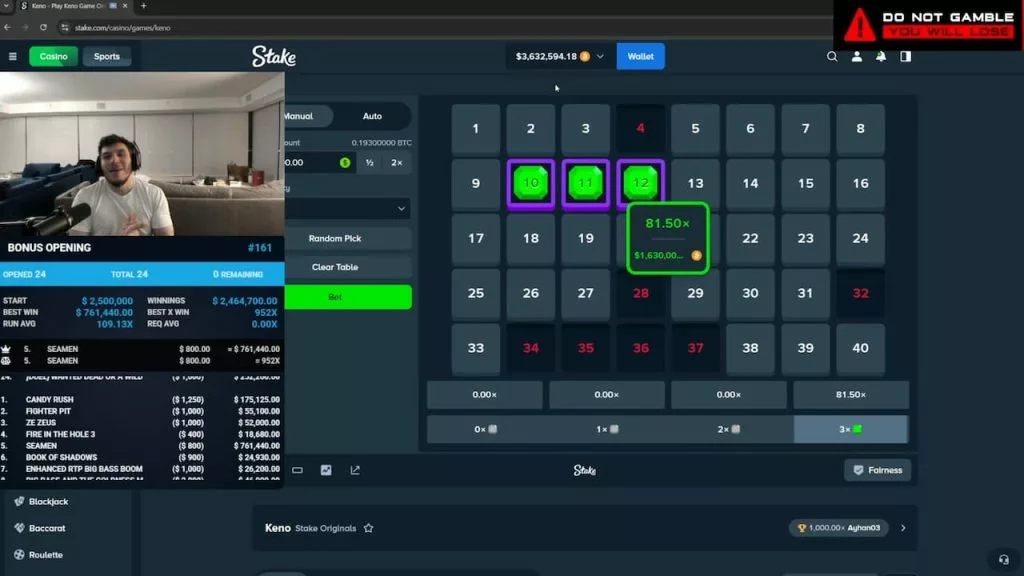
Keno mathematics involves combinatorics, probability theory, and expected value calculations. Understanding the underlying math reveals why certain outcomes occur at specific frequencies. https://crypto.games/keno/ethereum operate on transparent mathematical principles. Numerical literacy separates informed players from those gambling blindly.
Combinatorial calculations
Keno mathematics begins with combination formulas determining the total possible outcomes. Calculating ways to choose r items from n total uses factorial notation – nCr equals n factorial divided by r factorial times (n minus r) factorial. Selecting ten numbers from forty yields 40C10, equaling 847,660,528 possible combinations. Drawing twenty from forty creates 40C20, equaling approximately 137 billion combinations. These astronomical numbers explain why specific outcomes occur rarely despite seeming intuitively common.
Match probability derivation
Calculating the probability of matching specific numbers requires a hypergeometric distribution:
- Formula structure – Probability equals (ways to choose k hits from r selected) times (ways to choose misses from remaining) divided by total possible outcomes
- Practical application – Matching five of eight selections when twenty balls drawn requires calculating (8C5 * 32C15) / (40C20)
- Numerical results – This calculation yields approximately 0.0183 or 1.83% probability for five-match outcome
- Complete tables – Full probability distributions require calculating all possible match combinations from zero through maximum spots
Hypergeometric mathematics provides exact probabilities for every possible outcome.
Expected value computations
Expected value multiplies each outcome probability by its payout, then sums all products:
- Component calculation – Eight-spot ticket might pay 1500x for eight matches occurring 0.0043% of games yielding 6.45% contribution to expected value
- Aggregation process – Sum expected values across all payout tiers from minimum matches through perfect hits
- House edge extraction – Subtract calculated expected return from 100% revealing operator advantage percentage
- Optimization analysis – Compare expected values across different spot selections identifying most favorable options
Expected value analysis quantifies the exact mathematical disadvantage players face.
Payout structure optimisation
Operators design payout tables balancing player appeal against profitability targets. Lower match tiers pay small multipliers that occur frequently. Middle tiers offer moderate payouts at medium probabilities. Top tiers provide enormous multipliers compensating for terrible odds. Mathematical modelling tests various payout combinations, ensuring desired house edge percentages. Player psychology influences table design beyond pure mathematics since exciting big-win potential attracts participation despite poor overall odds.
Variance and standard deviation
Keno exhibits extreme variance with results deviating substantially from expectations over limited samples. Standard deviation measures the typical result spread around the mathematical mean. High standard deviation indicates wide outcome distributions common in lottery-style games. Calculating standard deviation requires squaring outcome differences from means, averaging squares, and then taking square roots. Understanding variance helps players maintain realistic short-term expectations despite knowing long-term mathematical certainties.
Statistical significance testing
Large sample sizes enable testing whether observed results match theoretical expectations. Chi-square tests compare actual outcome frequencies against predicted probabilities. Significant deviations indicate unfair games, though random chance produces occasional anomalies. Blockchain transparency enables players to conduct independent statistical audits across thousands of games. Proper significance testing requires understanding confidence levels and sample size requirements, preventing false conclusions from insufficient data.
Ethereum keno mathematics encompasses combinatorics, probability derivation, expected value calculation, payout optimisation, variance analysis, and significance testing. Numerical understanding reveals why outcomes occur at specific frequencies and why house edges guarantee long-term operator profitability. Mathematical literacy helps players make informed decisions while maintaining realistic expectations about gambling mathematics.